

It’s one of the first big decisions parents face, and it often gets made at a family dinner, based on what a cousin or a colleague chose. Here is the short version. The IB (International Baccalaureate) is built around questions, projects and connecting ideas across subjects. CBSE follows a set national syllabus, with board exams in Grades 10 and 12. Neither is better for every child. What matters is how your child learns, and where they might study later.
How IB and CBSE compare, day to day
Here’s a quick side-by-side:
|
|
IB |
CBSE |
|
Stages |
PYP (ages 3 to 12), MYP (ages 11 to 16), Diploma Programme (ages 16 to 19) |
Pre-primary to Grade 12 |
|
How children learn |
Inquiry, projects and concepts linked across subjects |
A defined syllabus, largely based on NCERT textbooks |
|
Assessment |
Ongoing and criteria-based; formal external exams mainly in the Diploma years |
School exams, plus board exams in Grades 10 and 12 |
|
Recognition |
Accepted by universities in India and abroad |
Accepted across India; closely matches the syllabus of JEE and NEET |
|
Often suits |
Children who enjoy questions, research and presenting ideas |
Children who like clear structure; families focused on Indian entrance exams |
What “international” really means
A school’s name doesn’t tell you much on its own. When you’re comparing international schools in Goa, ask three simple questions: which programme does the school follow, is it authorised to teach it, and how are its teachers trained? For IB programmes, you can check any school’s current status on the IB’s official website, ibo.org.
How it works at Rising India School of Excellence
At Rising India School of Excellence, you don’t have to choose a board when your child is three.
- Ages 3 to 6: our D.I.S.C.O.V.E.R.Y. Mind curriculum, covering nine areas from design thinking and scientific thinking to vocabulary and ethical education.
- Grades 1 to 5: the IB Primary Years Programme (Rising India School of Excellence is an IB school and an IB PYP candidate school), built around themes such as “How the World Works” and “Sharing the Planet”.
- From Grade 6: children continue on the IB pathway, with CBSE available as an option for families who want it.
- Grades 11 and 12: both the IB and CBSE pathways continue.
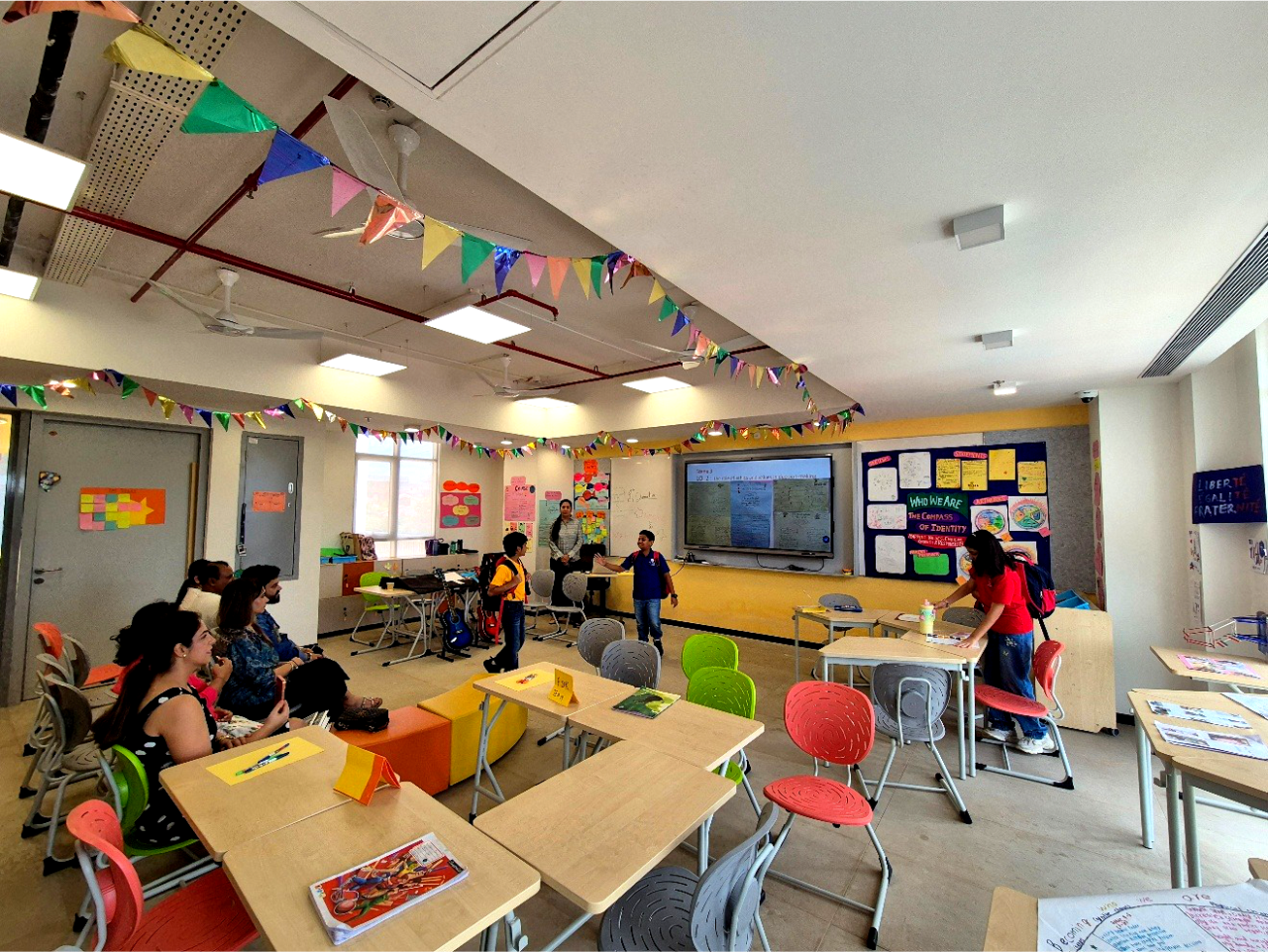
By Grade 6, you and our teachers will have watched your child learn for years, so the choice rests on what you’ve actually seen. Whichever path they take, the Apple-enabled classrooms, the weekly Impact Hour, Creator Hours for project work and 40 hours of community service stay the same.
Questions worth asking on a school visit
If you’re visiting IB schools in Goa, these five questions will tell you a lot:
- Which IB programmes is the school authorised for, and which are still in candidacy?
- How many teachers have completed official IB training?
- What’s the plan for Grades 11 and 12?
- If a child moves to or from another board, how does the school help them catch up?
- What does the fee include, and how has it changed in recent years?
A school that’s confident in its programme will answer without hesitation. We’re happy to walk you through our answers when you visit.
So which one suits your child?
A few patterns we see often:
- A child who keeps asking “why” and loves building, drawing or presenting often does well with inquiry-led learning.
- A family set on JEE or NEET may lean towards CBSE from Grade 6, when the syllabus starts lining up with those exams.
- A family that may move cities or countries often values the IB, because the same programmes run in schools around the world.
These are tendencies, not rules. IB students do sit Indian entrance exams, and plenty of CBSE students go on to study abroad. Before you decide, talk to your child’s teachers. They notice things in class that parents don’t always see at home.
Curious about the early years? Read why the Primary Years Programme matters and what sets Rising India School of Excellence apart, or book a tour to see an inquiry-led classroom for yourself.
Questions parents often ask
Is Rising India School of Excellence an IB school?
Yes. Rising India School of Excellence is an IB school, and an IB PYP candidate school. Grades 1 to 5 follow the IB Primary Years Programme, built around inquiry, projects and real-world learning. From Grade 6, children continue on the IB pathway, and families can also choose CBSE. You can check any school’s current IB status on ibo.org.
Is IB harder than CBSE?
Not harder, just different. IB asks for more independent research, writing and presenting. CBSE asks for a thorough command of a set syllabus ahead of board exams.
Can my child switch from IB to CBSE later?
Yes, though it’s easiest at natural transition points such as Grade 6 or after Grade 10. At Rising India School of Excellence, Grade 6 is when families who prefer CBSE can opt for it.
Do Indian universities accept the IB Diploma?
Yes. The Association of Indian Universities (AIU) recognises the IB Diploma as equivalent to Class 12, though individual courses may set their own subject requirements.
Is the IB pathway more expensive?
Usually, yes, because of teacher training, programme fees and smaller classes. Compare what each fee includes, not just the headline number.